 Feeling Wheel
The feelings wheel app
Name what you're feeling.
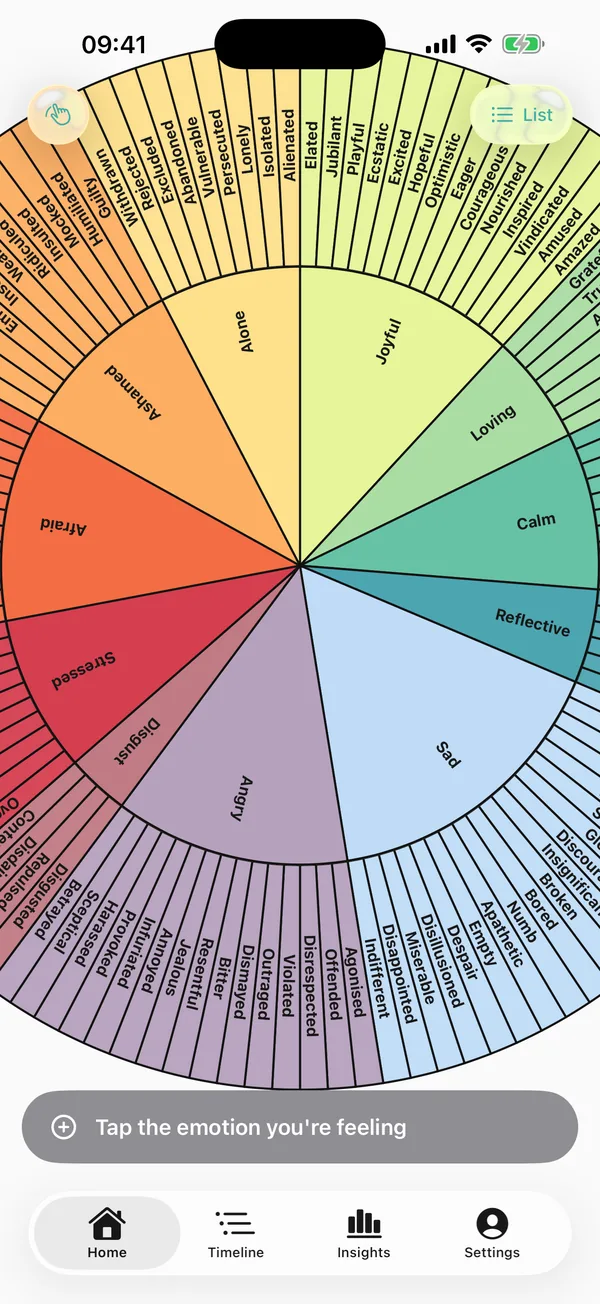
Feeling Wheel turns the feelings wheel, also called the emotion wheel, into a quick check-in. Tap to find the word for what you're feeling, log it in seconds, and see your patterns over time.
Rated 4.7 on the UK App Store and 4.8 in the US (iPhone)
Free to download · iPhone and Android · English, French, Spanish, Portuguese and German
"Fine" isn't a feeling
Naming an emotion precisely is the first step to understanding it. It's also harder than it sounds.
The problem
- In the moment, the right word is hard to find, so everything becomes "stressed" or "fine".
- Feelings pass without being noticed, so the same patterns repeat unseen.
- Journaling apps ask for paragraphs when you have thirty seconds.
How Feeling Wheel helps
- The wheel puts emotion words in front of you, and recognising a feeling is far easier than recalling one.
- Logging takes seconds: tap the emotions that fit, add a note if you want, done.
- History and Insights turn your entries into patterns you can actually see.
What is a feelings wheel?
A feelings wheel, also called a feeling wheel or emotion wheel, is a circle of emotion words. Broad feelings like sad, angry or joyful sit near the middle, and more specific words like disappointed, resentful or hopeful sit around the edge. You start with the broad feeling that's closest to how you are, then move outwards until you find the word that fits.
Therapists and counsellors use it to help people put a name to what they feel. Psychologist Robert Plutchik published his wheel of emotions in 1980, and Gloria Willcox published The Feeling Wheel in 1982. Most feelings wheels you'll find today, printed or online, are based on one of those two.
The Feeling Wheel app makes the wheel interactive. Instead of reading a printed chart, you tap the words that fit, save them as an entry with an optional note, and build up a private history you can look back on.
How to use a feelings wheel
- Pause and notice the general shape of the feeling. Is it closer to sad, stressed, afraid or joyful?
- Open that part of the wheel and read the more specific words.
- Pick the word, or words, that fit best. It's normal to feel more than one thing at once.
- Write a line about what happened, if you want to remember the context.
The words on the Feeling Wheel
118 emotion words in 11 groups. These are the words you can choose from in the English version of the app, and Pro lets you add your own. Tap a word to read what it means, or see every word with its meaning.
Joyful
elated, jubilant, playful, ecstatic, excited, hopeful, optimistic, eager, courageous, nourished, inspired, vindicated, amused, amazed
Loving
grateful, trusting, accepting, proud, admiration, awe, compassionate
Calm
confident, relaxed, peaceful, powerful, relieved, grounded, resilient, capable, content, settled
Reflective
intrigued, contemplative, conflicted, nostalgic, determined, confused
Sad
bleak, depressed, hurt, deflated, melancholy, sorrowful, gloomy, discouraged, insignificant, broken, bored, numb, apathetic, empty, despair, disillusioned, miserable, disappointed, indifferent
Angry
agonised, offended, disrespected, violated, outraged, dismayed, bitter, resentful, jealous, annoyed, infuriated, provoked, harassed, sceptical, betrayed
Disgust
Stressed
overwhelmed, rushed, distracted, frustrated, pressured, scattered, restless, impatient, depleted, burdened
Afraid
scared, shocked, anxious, nervous, helpless, frightened, worried, threatened, hesitant, horrified, cautious, doubtful, exposed
Ashamed
inadequate, inferior, worthless, embarrassed, insecure, weak, ridiculed, insulted, mocked, humiliated, guilty
Alone
withdrawn, rejected, excluded, abandoned, vulnerable, persecuted, lonely, isolated, alienated
Everything you need, nothing you don't
The feelings wheel
A trusted therapy tool, made interactive. Start from broad categories and drill into the specific emotion that fits, with a short description for every word.
Quick logging
Capture several emotions in one entry, with an optional note for context. It takes seconds, not minutes.
History
Every entry in one timeline. Filter by emotion or date to revisit how a week really went.
Insights
Trends, calendars and top-emotion charts that turn your entries into patterns you can see.
Your data, portable
With Pro, export your full history as a CSV file to take to therapy or keep for your own records.
Private by design
No account and no sign-up. Your entries and notes are stored on your phone, and nobody else can read them.
Reminders and widgets
On iPhone, a daily check-in reminder and a Home Screen widget help you build the habit.
How it works
Tap the wheel
Browse the wheel and pick the emotions that match what you're feeling right now.
Log it
Add an optional note for context, then save. Your entry goes straight into History.
Spot the patterns
Open Insights to see trends over days, weeks and months, and what drives them.
What people say
From App Store reviews.
"So easy to use and incredibly helpful way to identify and regulate emotions. I really appreciate the definition for each feeling being included, and the option to attach notes to feelings!"
"The feeling wheel is key in uncovering more about what and how you are feeling. I upgraded on second day because I knew I was going to use it."
"It's great and simple that makes it so useful and powerful to keep a log of how I feel and identify a theme with my emotions."
Questions about the feelings wheel
Is it called a feeling wheel, a feelings wheel or an emotion wheel?
All three names describe the same tool. Gloria Willcox called her 1982 version The Feeling Wheel, and today people search for feelings wheel, emotion wheel, emotions wheel and wheel of emotions just as often. In French it is the roue des émotions, in Spanish the rueda de las emociones, in Portuguese the roda das emoções, and in German the Gefühlsrad.
Where does the feelings wheel come from?
Therapists have used emotion wheels since the 1980s. Psychologist Robert Plutchik published his wheel of emotions in 1980, and Gloria Willcox published The Feeling Wheel in 1982. They all work the same way: start with a broad feeling, then move towards a more specific word. The wheel in the Feeling Wheel app is its own version, with 118 words chosen for everyday check-ins.
How do I use a feelings wheel?
Start with the group closest to how you feel, such as sad, stressed or joyful. Then read the more specific words in that group and pick the one that fits best. In the Feeling Wheel app you can choose up to 15 emotions in one entry and add a diary note if you'd like. Check in whenever suits you. There's no right number of times a day.
Why name my emotions?
Research on affect labeling suggests that putting a feeling into words can make it feel less intense. Naming it more precisely also makes it easier to spot patterns over time and to tell other people how you feel.
Is the Feeling Wheel app free?
Yes. Feeling Wheel is free to download on iPhone and Android. The wheel, your history and diary notes are free for everyone. An optional Pro upgrade adds the full Insights charts, history filters, data export, custom emotions and more.
Where are my entries stored?
Only on your phone. There's no account to sign up for and no copy of your diary on a server.
Which languages is Feeling Wheel available in?
English, French, Spanish, Portuguese and German. The wheel, the emotion descriptions, the app and the widgets are all translated on iPhone. On the French App Store the app is called Roue des émotions, on the Spanish and Mexican App Stores it is called Rueda de las emociones, on the Brazilian and Portuguese App Stores it is called Roda das Emoções, and on the German App Store it is called Rad der Gefühle.
Is this app a replacement for therapy?
No. It's a tool for noticing and naming your feelings. Many people use it alongside therapy, and Pro members can export their history to share with a therapist. If you feel unsafe, contact your local emergency services straight away.
Start noticing how you feel
Free to download. Logging your first feeling takes less than a minute.